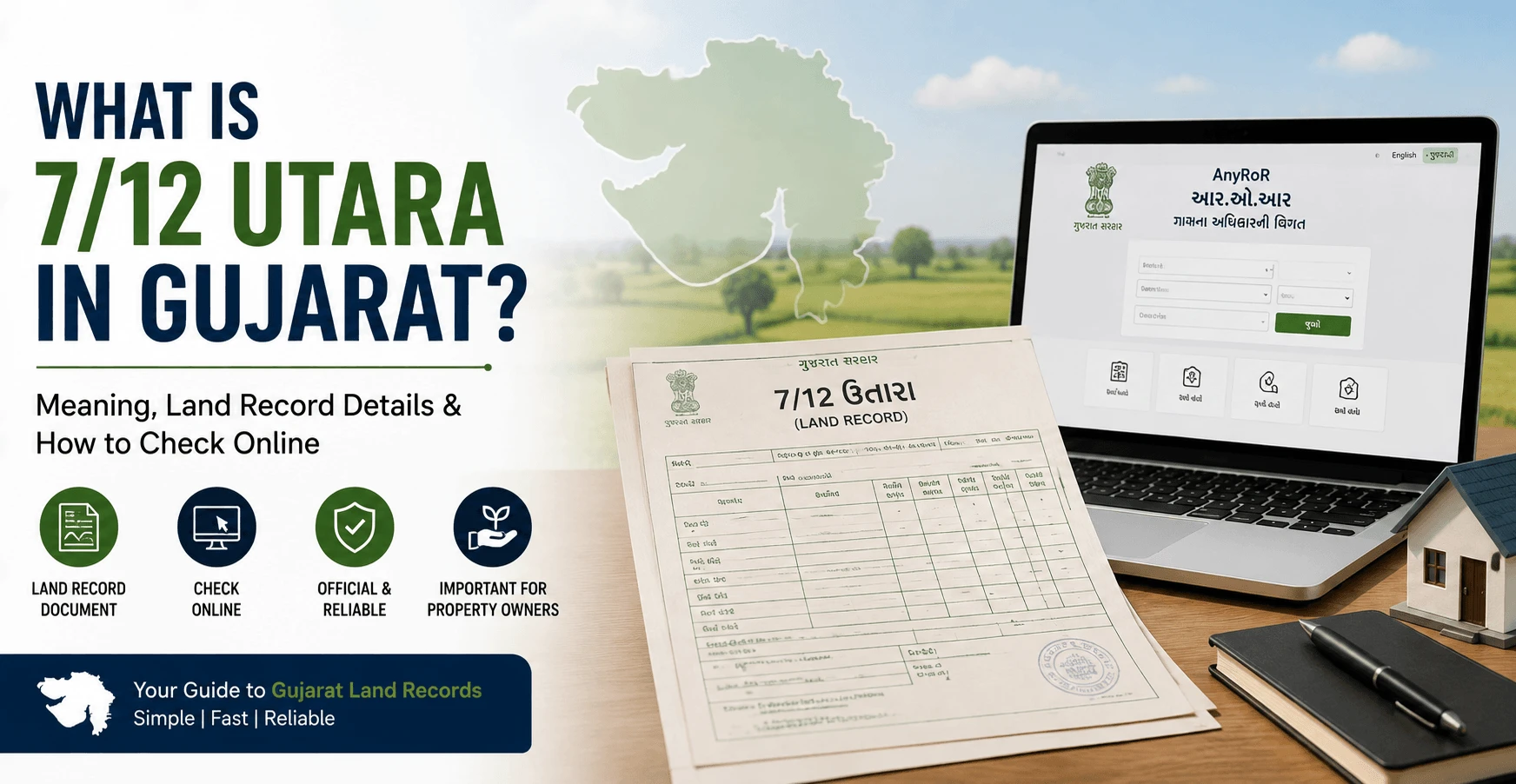
If you own agricultural land in Gujarat, are planning to purchase a plot of land, or want to verify land ownership and revenue records, you may have heard the term 7/12 Utara (7/12 ઉતારો).
The 7/12 Utara, also known as Village Form 7/12 (VF 7/12) or Satbara Utara, is an important land record used in Gujarat. It forms part of the state's Record of Rights (RoR) system and contains important information related to a land parcel, its holder/occupant, area, cultivation and other recorded rights.
Gujarat has digitised its village land records through the e-Dhara system. The Gujarat government states that e-Dhara was created to digitise village land records and facilitate activities such as mutations and issuing Records of Rights. The system covers VF 6, VF 7/12 and VF 8A.
Whether you are a farmer, landowner, property buyer or someone researching land in Gujarat, understanding the 7/12 Utara can help you interpret the basic revenue records associated with a property.
What Is 7/12 Utara in Gujarat?
In Gujarat, 7/12 Utara is a village land record that forms part of the Record of Rights (RoR).
It provides important information recorded against a particular agricultural land parcel, such as:
-
Survey number
-
Landholder/occupant information
-
Land area
-
Land-related rights
-
Cultivation information
-
Crop details
-
Irrigation information
-
Certain liabilities or other rights
-
Mutation-related changes
The Gujarat Revenue Department's documentation explains that the Record of Rights is maintained for every village and that land records include information concerning occupants/holders and transactions affecting the land. The digitised system records these changes through mutation entries and updates the relevant VF 7/12 and VF 8A records.
In simple words:
7/12 Utara is a government land record that helps you understand who is recorded in relation to a particular agricultural land parcel and what information is recorded about that land.
Why Is It Called 7/12?
The term 7/12 comes from the village record form number.
In Gujarat's land-record system, Village Form No. 7/12 (VF 7/12) is part of the Record of Rights.
It is commonly referred to as:
-
7/12 Utara
-
Satbara Utara
-
7/12 Extract
-
VF 7/12
-
Village Form 7/12
-
Record of Rights
The Gujarat government's e-Dhara project specifically identifies VF 7/12 as one of the principal land-record documents issued through the state's digitised Record of Rights system.
What Information Is Available in a Gujarat 7/12 Utara?
The exact fields displayed can vary depending on the land record and the particular village, but a 7/12 record can provide several important details.
| Information | What It Indicates |
|---|---|
| District | District where the land is situated |
| Taluka | Taluka/revenue subdivision |
| Village | Revenue village where the land is located |
| Survey Number | Identification number of the land parcel |
| Sub-division/Hissa | Particular portion of a survey number, where applicable |
| Khatedar/Holder Details | Person(s) recorded in relation to the land |
| Land Area | Recorded area of the land |
| Land Type/Classification | Relevant classification recorded in the revenue record |
| Cultivation Details | Information concerning cultivation |
| Crop Details | Crop-related information where recorded |
| Irrigation Details | Information about irrigation/water source where recorded |
| Other Rights | Certain rights, liabilities or restrictions recorded against the land |
| Mutation/Entry Information | Changes made to the land record |
| Remarks | Additional information recorded by the revenue authorities |
Gujarat's BhuLekh/e-Dhara system can query land information by criteria such as Khatedar name, Khata number, survey number and farm name, and its land-record database includes information relating to mutations, land use, land type, tenants, crops and irrigation.
What Is the Importance of 7/12 Utara?
The 7/12 record is important because it provides an official record of information maintained in the state's land-record system.
It can be useful for:
1. Checking Landholder Information
You can examine the person or persons recorded against the land.
This is particularly important when researching agricultural land before a transaction.
2. Identifying the Land Parcel
The Survey Number and other identifying information help connect the record with a specific parcel of land.
3. Checking Land Area
The record can be compared with other property documents and survey information to identify discrepancies.
4. Understanding Agricultural Use
The land-record system includes agricultural information such as crops and irrigation-related details where available.
5. Checking Revenue Record Changes
Mutation entries are used to record changes in the Record of Rights. Gujarat's e-Dhara system was specifically designed to computerise and manage these changes.
6. Property Due Diligence
If you are considering purchasing agricultural land, the 7/12 should be one of the documents examined as part of broader property due diligence.
However, 7/12 alone should not be treated as conclusive proof of clear legal title. A buyer should also verify the underlying title documents, registered deeds, mutation entries, encumbrances, applicable land-use restrictions and other relevant records.
How to Check 7/12 Utara Online in Gujarat?
Gujarat has digitised its land-record system through e-Dhara. The government describes e-Dhara as the system for computerised village land records and Record of Rights services.
The online land-record service is commonly associated with the AnyRoR system, through which users can access Gujarat land-record information.
Step 1: Open the Gujarat Land Record Service
Visit the Gujarat government's land-record service/AnyRoR portal.
Use the official Gujarat government land-record service rather than relying on third-party websites when checking property records.
Step 2: Select the Relevant Record
Depending on the service/interface available, select the appropriate Record of Rights option, such as:
VF 7/12
You may also find options relating to:
-
VF 6
-
VF 8A
-
Other land-record information
The Gujarat government identifies VF 6, VF 7/12 and VF 8A as key Record of Rights documents.
Step 3: Select District
Choose the district where the land is located.
For example:
-
Ahmedabad
-
Gandhinagar
-
Surat
-
Vadodara
-
Rajkot
-
Mehsana
-
Anand
-
Kheda
-
Bharuch
-
Bhavnagar
-
Junagadh
-
Jamnagar
-
Other Gujarat districts
Step 4: Select Taluka
Select the appropriate taluka.
The taluka must correspond to the location of the agricultural land.
Step 5: Select Village
Select the revenue village where the land is located.
Step 6: Enter the Required Land Details
Depending on the search option available, you may be able to search using details such as:
-
Survey Number
-
Khatedar/holder name
-
Khata number
-
Other available land identifiers
Gujarat's BhuLekh system supports searching land records using several identifiers, including Khatedar name, Khata number and survey number.
Step 7: Submit the Search
Enter the required information and submit the search.
The system will retrieve the available land-record information corresponding to the selected location and identification details.
Step 8: Check the 7/12 Record
Once the record is displayed, carefully compare:
-
Holder name
-
Survey number
-
Land area
-
Land type
-
Cultivation details
-
Other rights
-
Mutation/entry information
-
Other remarks
What Details Do You Need to Check 7/12 Online?
Before searching for a land record, it is useful to keep some basic property information ready.
| Required Information | Why You May Need It |
|---|---|
| District | Identifies the revenue district |
| Taluka | Identifies the revenue subdivision |
| Village | Identifies the revenue village |
| Survey Number | Identifies the land parcel |
| Khata Number | Helps identify the relevant account |
| Khatedar Name | Can be useful for name-based searches |
| Farm/land details | May help identify the correct record |
If you are buying land, the Survey Number is especially important because it can be used to match the revenue record with the property documents and physical land.
What Is VF 6 in Gujarat?
While checking Gujarat land records, you may also encounter VF 6.
VF 6 is associated with mutation entries in the Record of Rights.
A mutation entry records a change affecting the land record.
For example, changes may arise because of:
-
Sale
-
Inheritance
-
Gift
-
Partition
-
Succession
-
Other changes in land rights
The Gujarat government's land-record documentation states that mutation entries are made in Village Form No. 6, after which certified changes are reflected in the relevant Village Form 7/12 and 8A records.
Simple example
Suppose a piece of agricultural land is transferred from one person to another.
The transaction may result in a mutation process.
The change is recorded through the relevant mutation entry, and after the prescribed process and certification, the updated information is reflected in the relevant Record of Rights.
What Is VF 8A in Gujarat?
VF 8A is another important component of Gujarat's Record of Rights system.
It is generally associated with khata/account-related land information.
The Gujarat government's e-Dhara project specifically lists VF 6, VF 7/12 and VF 8A as Record of Rights documents available through its digitised land-record system.
Therefore, when researching land in Gujarat, it can be useful to examine the 7/12 together with the relevant 8A and mutation information rather than looking at only one record.
Difference Between VF 6, 7/12 and 8A
| Record | Main Purpose |
|---|---|
| VF 6 | Mutation/change entries affecting land records |
| VF 7/12 | Land rights/holder and agricultural land information |
| VF 8A | Khata/account-related land information |
| Record of Rights (RoR) | Broader land-rights record system incorporating relevant village forms |
The Gujarat government's e-Dhara system specifically handles VF 6, VF 7/12 and VF 8A as part of its digitised land-record services.
What Is e-Dhara in Gujarat?
e-Dhara is Gujarat's computerised land-record management system.
It was introduced to digitise village land records and make Record of Rights services more accessible.
According to Gujarat Informatics Limited, e-Dhara centres were established at Taluka Mamlatdar offices to handle land-record activities such as:
-
Mutation
-
Issuing Records of Rights
-
Maintaining electronic land records
-
Updating land records
-
Providing computerised copies of RoR
The system also allows land records to be searched using information such as Khatedar name, Khata number and Survey Number.
The Gujarat government states that e-Dhara has been implemented across the state, with e-Dhara Kendras and RoR services available through village-level channels as well.
AnyRoR and 7/12 Utara
You may often see the term AnyRoR when searching online for Gujarat land records.
AnyRoR refers to the online Record of Rights service used for accessing Gujarat land-record information.
The term is commonly expanded as Any Records of Rights Anywhere.
The service is designed to make land-record information accessible without requiring a person to visit the revenue office for every basic record search.
However, for important property transactions, it is advisable to verify the record through the appropriate official government channel and obtain authenticated/official copies where required.
7/12 Utara vs 8A: What's the Difference?
This is a common question among Gujarat landowners.
| Feature | 7/12 Utara | 8A |
|---|---|---|
| Record Type | VF 7/12 | VF 8A |
| Part of RoR system | Yes | Yes |
| Landholder information | Yes | Yes, in relevant account context |
| Survey/land details | Important component | Account/holding-related information |
| Agricultural information | Can include cultivation/crop information | Different focus |
| Mutation relationship | Updated following certified changes | Updated as part of land-record changes |
| Use in property verification | Important | Important |
| Should be checked alone? | No | No |
For a detailed land verification, it is better to examine the relevant 7/12, 8A and mutation entries together.
How to Check Land Ownership in Gujarat?
If you want to verify who is recorded in relation to a piece of agricultural land, you can begin by checking the relevant Record of Rights.
A practical verification process is:
1. Find the Survey Number
Obtain the Survey Number from the seller or existing property documents.
2. Search the 7/12
Use the relevant Gujarat land-record service to locate the VF 7/12 record.
3. Check the Recorded Holder
Compare the name shown in the record with the seller's identity and property documents.
4. Check VF 8A
Examine the relevant account/holding information.
5. Check VF 6
Look at mutation entries to understand how the current record came into existence.
6. Compare With the Registered Deed
Do not stop at the revenue record.
Compare the information with the registered sale deed, inheritance documents, partition documents or other documents applicable to the property.
7. Verify the Physical Property
Confirm that the Survey Number and boundaries correspond to the actual land.
What Should You Check Before Buying Agricultural Land in Gujarat?
If you are planning to buy agricultural land in Gujarat, checking the 7/12 is only the beginning.
Use the following checklist:
| Check | Why It Is Important |
|---|---|
| 7/12 Utara | Check recorded land and holder information |
| VF 8A | Check account/holding-related information |
| VF 6 / Mutation Entries | Understand changes in the land record |
| Survey Number | Confirm the exact land parcel |
| Land Area | Compare with sale deed and physical measurement |
| Holder Name | Compare with seller's identity |
| Other Rights/Remarks | Identify relevant recorded rights or restrictions |
| Previous Documents | Trace the history of the property |
| Registered Sale Deed | Verify the transaction/title document |
| Encumbrances | Check for mortgages or other claims |
| Land Use | Verify whether the intended use is legally permitted |
| Restrictions | Check applicable restrictions on transfer/use |
| Court Disputes | Conduct appropriate legal due diligence |
| Physical Survey | Confirm actual boundaries and area |
Is 7/12 Utara Proof of Ownership in Gujarat?
The 7/12 is an important Record of Rights/revenue record, but you should not treat it as the only document establishing absolute legal ownership.
For example, if a person is recorded as the holder in a 7/12, you should still examine the documents supporting that person's rights.
A proper property due-diligence process may include:
-
Current 7/12
-
VF 8A
-
VF 6/mutation history
-
Registered sale deeds
-
Previous title documents
-
Inheritance documents, if applicable
-
Partition documents, if applicable
-
Encumbrance-related records
-
Applicable government permissions
-
Land-use status
-
Survey/boundary records
-
Relevant court/dispute searches
The Gujarat government's own land-record documentation describes the Record of Rights as the principal revenue record from which land-right information and subsequent transactions are recorded.
Therefore, 7/12 is an important document for property verification, but a complete title search should go beyond the 7/12.
What If the Name on 7/12 Is Wrong?
Sometimes the name, area or other information in a land record may not match the person's current documents.
In such cases, the appropriate revenue process may involve a mutation/correction application and supporting documents.
Gujarat's e-Dhara system provides a defined workflow for mutation applications. The Gujarat Revenue Department's documentation explains that applications are submitted with required supporting documents, processed through the e-Dhara system and subject to the applicable notice and certification procedure.
If you find a discrepancy:
-
Compare the current 7/12 with previous records.
-
Check the relevant VF 6 mutation entry.
-
Identify the document supporting the change.
-
Collect supporting documents.
-
Contact the appropriate Talati/e-Dhara centre/revenue authority.
-
Follow the prescribed mutation or correction procedure.
For an important property transaction, obtaining professional legal/revenue assistance can be advisable.
Can 7/12 Be Used for Property Transactions?
Yes, 7/12 is an important document to examine during land transactions, particularly for agricultural land.
However, it should not be the sole document used to decide whether to purchase a property.
A buyer should verify the complete chain of title and applicable restrictions before entering into a transaction.
For example:
7/12 → VF 8A → VF 6 → Title Documents → Registered Deed → Encumbrance/Claims → Land Use → Physical Survey
This provides a much more comprehensive picture than checking the 7/12 alone.
7/12 Utara for Agricultural Land vs Urban Property
The relevance of 7/12 depends on the nature and location of the property.
| Property Type | Records You May Need to Examine |
|---|---|
| Agricultural Land | 7/12, 8A, VF 6 and relevant title documents |
| Land with Recent Mutation | 7/12 + VF 6 + supporting documents |
| Inherited Agricultural Land | 7/12 + mutation + succession/inheritance documents |
| Partitioned Land | 7/12 + mutation + partition documents |
| Urban Property | Applicable city/municipal/property records and title documents |
| Land Being Converted/Developed | Revenue records + applicable NA/land-use permissions + development approvals |
Therefore, before buying a property in Gujarat, first determine what type of property it is and which revenue/municipal records apply to it.
Common Mistakes to Avoid When Checking 7/12
Mistake 1: Checking Only the Owner's Name
A name match does not complete the title verification process.
Mistake 2: Ignoring VF 6
Mutation entries can provide important information about how changes occurred in the land record.
Mistake 3: Ignoring 8A
For a complete revenue-record review, the relevant 8A information should also be considered.
Mistake 4: Not Checking the Survey Number
Always ensure the record belongs to the actual property being purchased.
Mistake 5: Not Comparing Land Area
Compare the recorded area with the registered documents and physical measurement.
Mistake 6: Relying on Third-Party Websites
For important property decisions, use the official Gujarat government land-record services wherever possible.
Mistake 7: Assuming 7/12 Guarantees Clear Title
A revenue record is not a replacement for a complete legal title search.
Frequently Asked Questions About 7/12 Utara in Gujarat
What is 7/12 Utara in Gujarat?
7/12 Utara, or VF 7/12, is an important village land record forming part of Gujarat's Record of Rights. It contains information relating to landholders/occupants and the relevant land parcel, along with agricultural and other recorded information.
What is VF 7/12?
VF 7/12 means Village Form 7/12. It is one of the key Record of Rights documents in Gujarat's land-record system.
What is AnyRoR?
AnyRoR is the online Record of Rights service associated with Gujarat's digitised land-record system. It allows users to access land-record information online.
Can I check 7/12 online in Gujarat?
Yes. Gujarat has digitised its village land records through the e-Dhara system, and Record of Rights services are available through online and government service channels.
What information is required to search 7/12?
Depending on the search facility, you may need information such as the district, taluka, village, Survey Number, Khata Number or Khatedar name.
What is VF 6?
VF 6 is associated with mutation entries in Gujarat's Record of Rights. These entries record changes affecting land rights and are reflected in the relevant land records after the prescribed process.
What is VF 8A?
VF 8A is another important Record of Rights document associated with landholder/khata information in Gujarat. Gujarat's e-Dhara system provides VF 8A along with VF 6 and VF 7/12.
Is 7/12 the same as a sale deed?
No. A 7/12 is a revenue/Record of Rights document, while a sale deed is a registered document relating to a property transaction. They serve different purposes.
Can I buy land based only on 7/12?
It is not advisable. Before purchasing land, conduct a complete title and property due-diligence process, including checking the relevant 7/12, 8A, mutation entries and underlying title documents.
What should I check first when buying land in Gujarat?
Start with the Survey Number, then verify the 7/12, 8A and mutation history. After that, compare the information with the registered title documents and physically verify the property.
7/12 Utara: Quick Summary
| Question | Answer |
|---|---|
| What is 7/12 Utara? | Gujarat's Village Form 7/12, an important Record of Rights document |
| Also called | Satbara Utara, 7/12 Extract, VF 7/12 |
| State | Gujarat |
| Main purpose | Recording important land-right and agricultural information |
| Related records | VF 6 and VF 8A |
| VF 6 | Mutation/change entries |
| VF 8A | Khata/holding-related information |
| Land records system | e-Dhara |
| Can records be accessed online? | Yes |
| Important search details | District, Taluka, Village, Survey Number, Khata/Khatedar information |
| Important for land buyers? | Yes |
| Is 7/12 alone sufficient for title verification? | No |
| Should mutation entries be checked? | Yes |
| Should title documents also be checked? | Yes |
Final Words
The 7/12 Utara is an important land record for understanding agricultural land in Gujarat. It forms part of the state's Record of Rights and works together with other records such as VF 6 and VF 8A.
Gujarat's e-Dhara system has digitised village land records and provides access to Record of Rights services, including VF 6, VF 7/12 and VF 8A.
If you are simply checking a property, start with the Survey Number and 7/12. If you are planning to purchase land, go further and check VF 8A, VF 6/mutation entries, title documents, registered deeds, applicable land-use restrictions and other relevant records.
The most important rule is simple:
Don't verify a property only by checking the 7/12. Verify the complete chain of title and the current legal status of the land.
This approach can help you identify discrepancies in ownership, land area, mutation history, recorded rights or other property-related issues before making an important land transaction.
